What does not change
Closing
A question with an answer
At the quarterly review in March, Begoña asked the usual question: what has changed thanks to AI? For the first time there was an answer with data. New members who joined the waiting list booked more classes in their first month than the others. Member services resolved more than half of the timetable queries with no wait. And a marketing initiative had been stopped before it spent its budget.
There was also an answer for what had not changed: cancellations in the first three months were still high. Nobody hid it. It was the next question in the backlog.
Ten common mistakes and their antidote
- The one-day Sprint because "everything is fast now". A Sprint lasts as long as it takes for the learning to come back, not as long as it takes to write the code.
- The backlog inflated by AI. The Product Owner prunes every week: generating is free, maintaining is not.
- A hundred generated stories and none of them prioritised. The four questions from chapter 9.
- The Review full of generated demos. Nothing goes into the Review without a usage measure.
- The Product Owner who accepts without reviewing. Every decision has a name behind it (chapter 3).
- The Daily with the bot's report. One single question: what do we decide today?
- "The agent is a team member". The agent is capacity; whoever integrates its work is accountable for it.
- Measuring lines of code or prompts. The seven measures from chapter 14, across the whole flow.
- The pilot with no stopping criterion. Write it down before you start.
- Buying licences before you have the use case. The use case backlog from chapter 16.
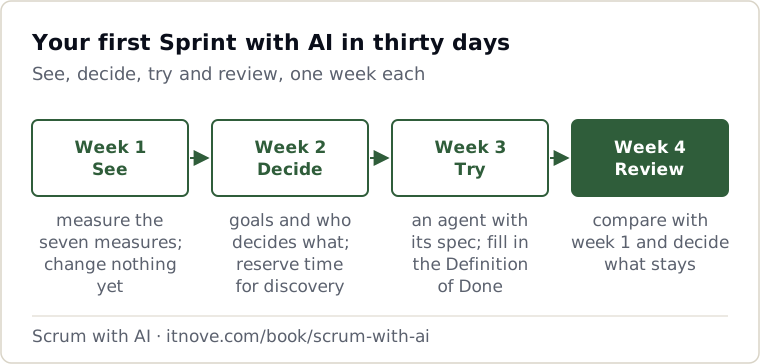
Your first Sprint with AI in thirty days
Week 1. See. Measure how the team works today with the seven measures from chapter 14 and take the Scrum Master's three questions to the Retrospective. Do not change anything yet.
Week 2. Decide. Write the goal ladder from chapter 12 and the who-decides-what table from chapter 3. Reserve capacity for the discovery track.
Week 3. Try. Give an agent a well-bounded piece of work with its spec. Add the missing lines to the Definition of Done. If you have something with AI inside, write down what it must never do.
Week 4. Review. Compare the measures with those from week 1. Decide what stays, what changes and what stops, and write it on one page.
What does not change
AI changes almost everything about how things are built and almost nothing about what matters. Someone has to decide what is worth doing, someone has to check that it works and someone has to answer for it when it goes wrong. Deciding, checking and answering are still work for people. Scrum, used well, is the way to do it in short cycles and with evidence.
Want to go further?
Each part of the book has its own course at ITNOVE:
- Accountabilities and events with AI (Parts I to III): Professional Scrum Master with AI (in Spanish) and Professional Scrum Product Owner with AI (in Spanish).
- Specs and teams with agents: Spec-Driven Development (in Spanish) and Leading development with AI (in Spanish).
- Goals, measurement and multiple teams (Part IV): Evidence-based roadmap (in Spanish), DORA and flow metrics (in Spanish) and SAFe fundamentals (in Spanish).
- AI in the company (Part V): AI governance (in Spanish), AI literacy (in Spanish) and the AI assessment (in Spanish) to get started.
And if you want to bring this to your team or your company, we do it with you: training for companies (in Spanish).
Glossary
The terms in the book (Sprint Goal, Definition of Done, EBM, value stream, AI agent, Spec-Driven Development, EU AI Act and the rest) each have an entry in the website glossary (in Spanish).