Part V. Adopting AI in the company with Scrum
Don't buy licences yet
The use case backlog and the pilot as a Sprint
An offer with an expiry date
The year began with three AI use cases on the table at GymTonic's committee. The member assistant, which was already in pilot. Recruitment campaigns written with AI, requested by Gema, the head of marketing. And automatic classification of supplier invoices, requested by the accounts department.
A vendor had offered licences for its platform for the whole workforce, with a discount if the deal was signed before the end of the month. Begoña was about to sign. Ramón asked for a month.
Implementing AI is complex work
Implementing AI in a company is complex work, of the kind described in chapter 1: you don't know which use cases will work, what data is missing or how people will react. That's why you don't manage it with a rollout plan. You manage it the way you manage a product: a backlog, short cycles, someone who decides, and reviews with the people who use it.
Buying licences for everyone before you know what they're for is the equivalent of building the whole product before talking to a customer.
The use case backlog
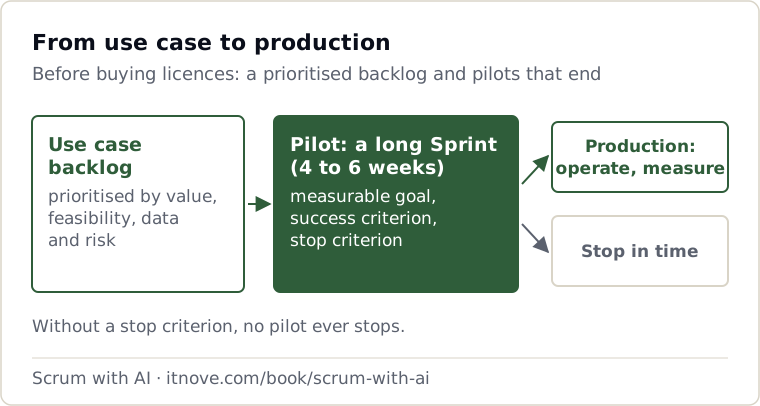
The inventory of use cases is a backlog. Every case is described the same way: what problem it solves, for whom, how it's measured today and what would change. And it's prioritised by four criteria:
- Value: how much it improves the outcome, measured in the business process and not in self-reported hours saved.
- Feasibility: whether today's AI can do it with sufficient quality.
- Data: whether the data exists, whether it's accessible and whether it can be used legally.
- Risk: what happens if it gets things wrong, who it affects and how much it costs.
Someone has to own that backlog: a Product Owner for adoption, with the authority to say no.
The pilot is a long Sprint
Every promising use case goes through a pilot, which works like a long Sprint, four to six weeks, with three things written down before it starts:
- A measurable goal. "Member services resolves 60% of timetable queries with no waiting."
- A success criterion. What result justifies moving to production.
- A stop criterion. What result, or what problem, makes it stop.
Without a stop criterion, no pilot ever stops. There's always "just a bit more" to do.
The pilot's Review is held with the business and with the people who will use the system, not just with the technology team. Mercedes and two receptionists attended the one for the assistant, and they were the ones who said which queries it must never answer.
From pilot to production
Moving to production doesn't mean leaving the pilot switched on. You have to operate it: periodic quality evaluations, monitoring of the signals from chapter 11, support for the people who use it, and one person who is accountable. The use case runs through its own value stream, the one from chapter 13, and the pilot has to measure all of it, adoption included.
Licences and a course are not enough
Half the work isn't the technology: it's changing how people work. Training the workforce is necessary, and the EU AI Act requires it (chapter 17), but it isn't enough. Someone has to redesign the process, people have to know what they must not delegate to AI, and they need someone to ask.
What happened at GymTonic
The member assistant met its success criterion and moved to production. The marketing campaigns were stopped in time: in two tests, the generated copy performed no better than the usual copy, and every piece had to be checked with a magnifying glass for brand and health issues. The invoices are on hold: half of them arrive as scanned paper with no structured data, and that has to be fixed first.
Begoña didn't sign the licences for the whole workforce. She bought the ones needed for the case that worked.
Stopping a use case in time is a success of the method, not a failure of the project.
In short
Implementing AI is complex work, and you manage it with a use case backlog prioritised by value, feasibility, data and risk. Every pilot is a long Sprint with a goal, a success criterion and a stop criterion. Moving to production means operating, and changing how people work is half the job.
Try it this week
Write down your AI use cases with the four criteria and choose one to stop. If you can't stop any of them, you don't have a backlog: you have a wish list.
To see where to start, you have the AI diagnostic (in Spanish) and the readiness sheet for starting with AI in your team (in Spanish). The complete plan, in a single table, is in Don't buy licences yet (in Spanish).