Part III. The Sprint with AI
Before you build, check that it is needed
Discovery and validation when building is cheap
The virtual trainer
The virtual trainer was the leadership team's big idea for GymApp: an AI that designs your routine, corrects you and encourages you. With AI, Germán had a working prototype in two days. Celia made it beautiful in two more. At the presentation to the committee, Begoña said it was exactly what she had seen at the conference.
Héctor already had two days per Sprint set aside for discovery, so he asked the question that needed asking: what problem is this for? The data they had was that GymTonic lost many members in the first three months. The assumption was that they left because they didn't know what to do at the gym. Nobody had checked.
Cheap to build, expensive to get wrong
If building is cheap, the risk moves. It is no longer taking too long to build. It is building what nobody needs. And AI doesn't make that cheaper. A virtual trainer that nobody uses costs the same as before in what really matters: months of the team's attention, a promise to members and a lost opportunity.
What AI speeds up, and what it doesn't
AI speeds up discovery (in Spanish) a lot. In an hour it summarises hundreds of opinions, proposes proto-personas from the data, prepares interview scripts and builds a prototype in an afternoon. All of that is useful.
What it doesn't do is replace the real member. It can tell you what people say in reviews, but not what someone does on a Tuesday at seven in the evening when they walk into the gym without knowing where to start. Only the member has that information.
Validate before you polish
A polished prototype reads as rigour and proves nothing. When something looks finished, people comment on the finish: the colours, the copy, the animation. And whoever made it tends to defend it.
That is why it pays to validate in grey: prototypes without final design, so the conversation is about the journey and not the look. Polished design comes when you know the journey works.
Ask about what they do today
A useful interview doesn't ask about the idea ("would you use a virtual trainer?"), because almost everyone says yes to something that sounds good. It asks about what the person does today: tell me about the last time you went to the gym and didn't know what to do. What did you do? Who did you ask? Did you go back?
For something that doesn't exist yet, you give the experience first and ask afterwards. A grey prototype that people actually use. Or someone who does by hand, for two weeks, what the system would do: an instructor who sends the day's routine by message to ten new members every day. With that, you can ask about what happened, not about what would happen.
Héctor and Celia talked to twelve members who had cancelled in the first quarter. Only two said they didn't know what to do. Most talked about schedules: the classes they wanted were always full at the times they could go. The virtual trainer wouldn't have fixed that. The waiting list and the open-spot alert might.
What comes out of the discovery track
What comes out of this isn't a feature: it is a hypothesis with its measure. Who will do what differently, and by how much. For example: "new members who join the waiting list book at least one class per week in their first month in 30% more cases than today." With that, delivery knows what to build and the Review knows what to look at.
And sometimes what comes out is that nothing should be built. Killing an idea early is a result, not a failure. The virtual trainer didn't die: it was parked until there is evidence that it solves a problem members actually have.
Five checks before you polish
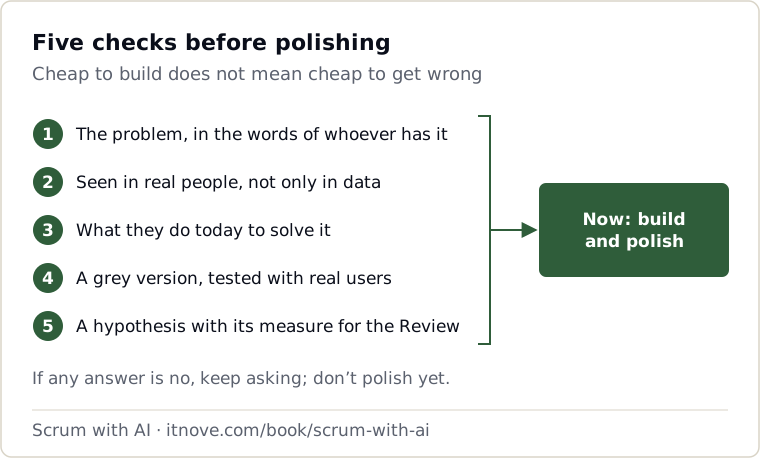
- Do we know what problem it solves, in the words of the people who have it?
- Have we seen it in real people, not just in data or reviews?
- Do we know what they do today to solve it?
- Have we tested a grey version with the people who would use it?
- Do we have a hypothesis with its measure for the Review?
If any answer is "no", it is not yet time to polish.
In short
If building is cheap, the risk is building what nobody needs. AI speeds up discovery, but it doesn't replace the real user. Validate in grey, ask about what people do today and come out of this with a measurable hypothesis, or with a discarded idea.
Try it this week
Pick the biggest idea in your backlog. Make a grey prototype and show it to five people who would use it. Before that, ask them about what they do today.
To prepare the interviews and summarise what comes out of them, the AI Kit for Product Owners (in Spanish) includes the context document and the discovery prompts.