Building is no longer the hard part
Introduction
I start with a real mistake of my own
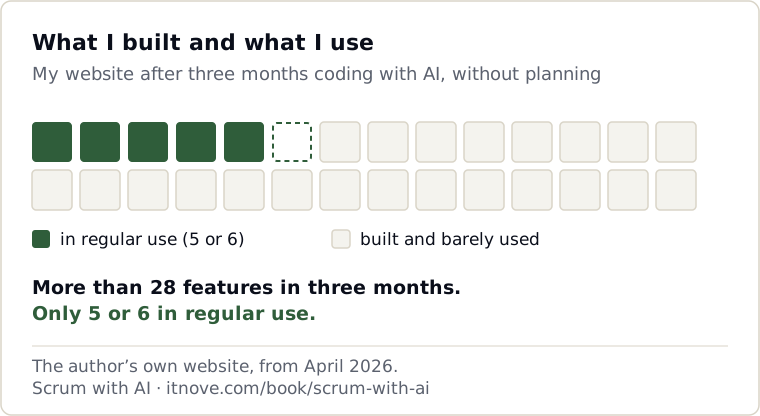
I started programming with Claude Code around April 2026. I couldn't believe how easy it was to build my website and its features. I thought: why plan? Why run Sprints? Let's just keep going. Three months later I found myself with more than 28 features on my website, of which I regularly used only 5 or 6. I, who have been teaching Scrum for 15 years, had fallen into the overproduction trap of Vibe Coding (in Spanish).
What this book argues
AI makes building cheaper. Today a team can have a working prototype in an afternoon, a decent specification in an hour and forty user stories in a minute. What it doesn't make much cheaper is deciding what is worth building, checking that what was built works and being accountable for it when something goes wrong.
Scrum exists to help teams make decisions. It wasn't created to hand out tasks or to protect a scarce team of programmers, even though many companies use it that way. It was created to work with evidence when you don't fully know what to do or how to do it: do something small, evaluate the result and decide the next step.
That is where the book's thesis comes from. If you used Scrum to protect the team's capacity, with AI you don't need half of its elements. If you use it to learn fast without losing control, you need it more than before.
Who it is for
For people who work with Scrum: Product Owners and Product Managers, Scrum Masters and Agile Coaches, Developers. For project managers and tech leads who work alongside Scrum teams and now also alongside AI agents. And for whoever has to roll out AI in their company and wants to do it with judgement, without buying licences blindly.
I assume you know what a Sprint is and that you have used some AI assistant. I don't assume you have worked with agents, that you have measured whether AI improves anything for you or that you know the EU AI Act.
How it is organised
- Part I covers what changes and what doesn't: what Scrum is for and why the bottleneck has moved.
- Part II is about people and agents: what is not delegated, what the Scrum Master does, what an agent is and how learning continues.
- Part III walks through the Sprint with AI: discovering and delivering at the same time, planning, the events and the Definition of Done.
- Part IV deals with goals, the value stream, measurement and working with several teams.
- Part V takes all of this to the company adopting AI: the use case backlog, the pilots and compliance.
How to read it
It takes an hour and a half to read. You can read it in one sitting or read Part I and jump to the one that concerns you. If you are here to roll out AI in your company, Parts I and V stand on their own.
Almost every chapter starts with a scene from GymTonic, a chain of gyms with its own app. GymTonic is fiction: it lets me show the real problems we find with clients without revealing anything private. What isn't fiction are the data and my own mistakes that I describe, especially those from our website, which we develop with AI agents every day.
Each chapter ends with something to try this week. They are not reflection exercises: they are a question for the next meeting, a list to fill in or a one-Sprint experiment.
I don't name tools or versions. They change every few months and would make the book outdated before I finished it. I talk about what AI can do, not about which product does it. What lasts is what always has: working with evidence, knowing who decides and measuring what matters.