Part I. What changes and what does not
Scrum is for what you don't know how to do yet
Complexity, empiricism and when not to use Scrum
Three initiatives and one sentence
Begoña, the CEO of GymTonic, came back from an AI conference with a sentence she repeated at Monday's management meeting: "AI in everything, and with Scrum." GymTonic has fourteen centres, about thirty-eight thousand members and its own app, GymApp, run by a team of six people.
There were three initiatives on the table. The first, an AI virtual trainer inside GymApp. The second, an assistant to answer members through chat and email, because member services can't keep up in January. The third, the opening of the fifteenth centre, with its construction work, its permits and an opening date already announced.
Lorena, the project manager who runs the openings, asked quietly whether the construction work was also going to be done "in Sprints". Nobody knew what to say. Ramón, the CTO, said Scrum was his team's business. Mercedes, the head of member services, asked what a Sprint was.
Complicated is not the same as complex
Scrum is not a way to hand out tasks. It is a way to decide with evidence when you don't fully know what to do or how to do it.
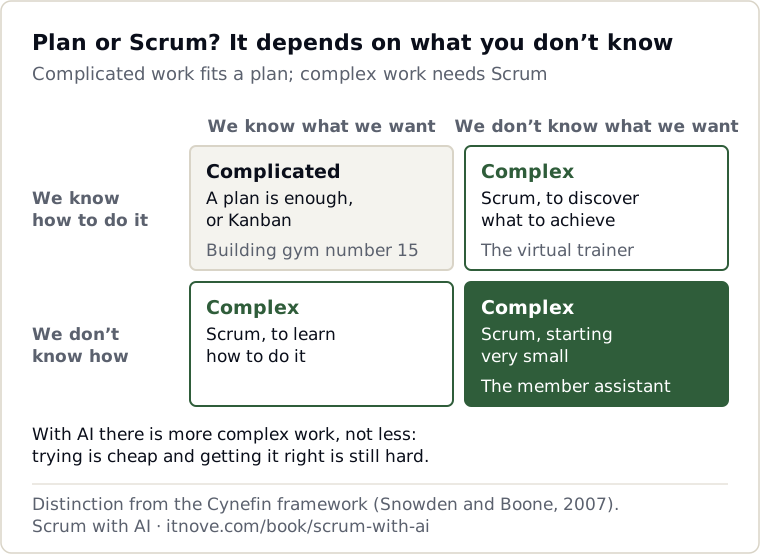
The difference that matters is between complicated work and complex work. It is the distinction from the Cynefin framework, which Dave Snowden and Mary Boone explained in Harvard Business Review in 2007. Complicated work has a solution an expert can plan in advance: building a gym, running payroll, migrating some servers for the tenth time.
There is uncertainty, but it is known. A good plan, with its milestones and risks, works.
Complex work can't be planned in full because the answer only appears by doing and looking at the result. You don't know whether members will use a virtual trainer until they try it. You don't know what questions they will ask an assistant until it goes live. There, a detailed plan is a bet disguised as certainty.
Scrum is made for the second type: short cycles, something usable at the end of each one, one person who decides what comes next and a review with the people who will use it. If the work doesn't have that uncertainty, Scrum adds meetings and contributes nothing.
At GymTonic, the virtual trainer and the member assistant are complex. The construction of the fifteenth centre is complicated: it needs a plan, someone in charge and risk tracking, and perhaps a Gantt-style schedule, or a Kanban (in Spanish) board to see the flow of permits and suppliers. Putting it in Sprints doesn't make it more agile; it makes it slower.
What changes with AI
With AI, the how gets cheaper. A prototype that used to take a month takes an afternoon. A specification that took a week comes out in an hour. That makes it tempting to think the work has become more predictable.
It is the other way round. If trying costs little, more things get tried, and each try brings an answer nobody knew. Or perhaps something else gets started without validating the result of the previous one, because it is tempting to do more and more. The what is as uncertain as before, and aiming at the wrong goal costs the same: months of work nobody uses.
That is why with AI there is more complex work, not less. More initiatives where the January plan doesn't survive until March.
This also happens outside software. An AI adoption programme in a company is textbook complex work: you don't know which use cases will work, what data is missing or how people will react. We will see this in Part V.
Six questions before using Scrum
Using Scrum where it doesn't belong discredits it. When a construction project "runs in Sprints" and fails, nobody blames the choice: they blame Scrum. Before deciding, six questions are enough:
| Question | If the answer is yes | If the answer is no |
|---|---|---|
| Do we know exactly what we want to achieve? | A plan may be enough | Scrum helps you discover it |
| Do we know how to do it? | Plan or Kanban | Scrum helps you learn it |
| Can we deliver something usable in a few weeks? | Scrum is viable | Split the work before starting |
| Is there one person who decides what goes first? | Scrum is viable | Without that person, Scrum doesn't work |
| Can we measure the effect of what we deliver? | Scrum makes use of that measure | Find a way to measure it first |
| Is being wrong expensive if we see it late? | Scrum detects it sooner | It may not be worth it |
If the first two are "yes", it is probably complicated work and a plan will do. If they are "no" and the rest are "yes", Scrum fits. If the person who decides is missing, no framework will save you: fix that first.
At GymTonic, the construction of the fifteenth centre answered "yes" to the first two. Lorena kept her plan and a board for the permits. The virtual trainer and the assistant answered "no" to the first two, and that is where this book begins.
In short
Scrum is for what you don't know how to do yet. With AI there is more work like that, not less, because trying is cheap and getting it right is still hard. What isn't complex deserves a plan, not a Sprint.
Try it this week
Take the three initiatives that worry you most and run them through the six questions with the person in charge of each. At least one shouldn't be run with Scrum. If they all come out "Scrum", repeat the exercise with someone from outside the team.
To review the rules of the framework, you have the 2020 Scrum Guide in Spanish (in Spanish). If one of your initiatives is more flow than discovery, the Kanban board template (in Spanish) will help you get started.