Part II. The team: people and agents
Some things cannot be delegated
Scrum accountabilities with AI, and who answers for what
Forty stories in one minute
Héctor, the Product Owner of GymApp, came to Product Backlog refinement with something he thought was a gift. He had run the app's twelve hundred store reviews through the AI and asked it for user stories. In one minute he had forty, well written, with their acceptance criteria.
Germán, the most senior developer, read the first five and asked which one was the most important. Héctor went to answer and realised he didn't know. None of them were his. They all sounded reasonable. Some asked for more classes in booking, others for a dark mode, others for the virtual trainer never to exist.
Olga, the Scrum Master, suggested ordering them by the number of reviews that mentioned them. Héctor said no and, as he said it, he understood what his job was that morning.
AI proposes; someone decides
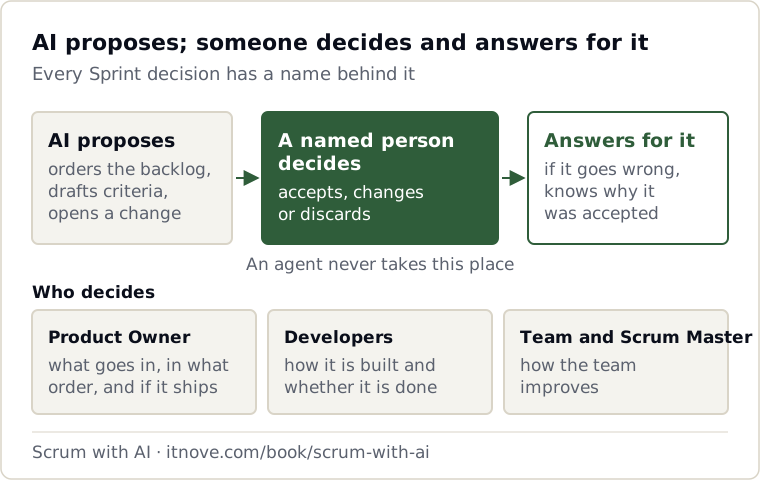
AI is very good at proposing. What it doesn't have is the accountability to decide, and nobody has given it that. Every decision in a Sprint needs a name behind it: someone who made it, knows why and answers for it if it goes wrong.
When that is missing, something subtle happens. Nobody decides badly; people simply accept what the tool proposes because it is well written. A backlog of forty generated stories is not a backlog: it is pruning work. The Product Owner's value is saying no to thirty-five of them, and being able to explain why.
What changes in each accountability
The Product Owner still decides value. What changes is the volume of what lands in front of them. Before, the bottleneck was writing the backlog; now it is choosing. The job looks more like an editor's than a writer's: cutting, ordering and making sense of things.
The Developers go from writing most of the code to specifying it, reviewing it and answering for it. "The AI wrote it" is not a valid explanation in a Sprint Review or in an incident. Whoever integrates it answers for it.
The Scrum Master still helps the team to self-manage (in Spanish). With AI there is a new job, making visible how the team uses AI, which deserves its own chapter: the next one.
The project manager is not redundant. In many companies they work alongside Scrum teams and manage what the team doesn't see: dependencies on suppliers, risks, commitments to third parties and budget. With AI, new commitments appear: contracts with model providers, data use terms, legal deadlines.
The tech lead is not redundant either. They watch over the architecture and quality that AI doesn't see: the code that works today and that nobody understands six months from now, the dependency that came in without review, the shortcut that compromises security.
An agent answers for nothing
That is why an agent is given work, never a decision. It can propose an order for the backlog, draft acceptance criteria or open a change in the code. It cannot decide that something is done, that something is worth it or that a risk is acceptable.
The EU AI Act requires it in writing for many uses: human oversight. But you don't need to wait for the law. Human oversight means there is a named person who reviews, understands and answers. Not a committee, and not a "we'll all review it together".
Who decides what
A quick way to make this visible is a table with the decisions in a Sprint and who makes them:
| Decision | Who decides | What AI can contribute |
|---|---|---|
| What goes into the Sprint and in what order | Product Owner, with the team | Group requests, summarise the evidence |
| How it is built | Developers | Propose approaches, write code |
| Whether a change is done | Developers, with the Definition of Done | Run tests, check style |
| Whether it is released | Product Owner | Summarise risks and results |
| Whether a risk is acceptable | The named person who answers for it | Flag risks |
| How the team improves | The team, with the Scrum Master | Analyse the Sprint data |
If in any row "the AI" or "nobody" decides, that is the first problem you need to solve.
Héctor left refinement with five stories. The other thirty-five didn't disappear: they stayed as evidence of what members are asking for, with no commitment to build them.
In short
AI proposes and someone decides. Every decision in the Sprint has a name behind it, and an agent never takes that place. The Product Owner edits more than writes; the Developers answer for what they integrate, whoever wrote it.
Try it this week
List five decisions an AI made in your team this week without anyone signing off on them: a story accepted as is, a change integrated without being read, a suggested backlog order. Put a name on each one. If you don't know whose it is, that is your next Sprint Retrospective topic.