Part III. The Sprint with AI
Five events, one question: what do we decide here?
Planning, Daily, refinement, Review and Retrospective with agents
Twelve tasks closed overnight
On Tuesday, at the GymApp Daily, the board had twelve new tasks in the review column. An agent had closed them overnight: text fixes, missing tests and two tweaks to the waiting list. Unai started reading them out loud. At the third one, Olga stopped the Daily.
"What do we need to decide today?" she asked. Nobody knew. They had spent ten minutes going over what the agent had done, and the waiting list, which was the Sprint Goal, was still blocked by a question about payments that nobody had mentioned.
An event that decides nothing is a meeting
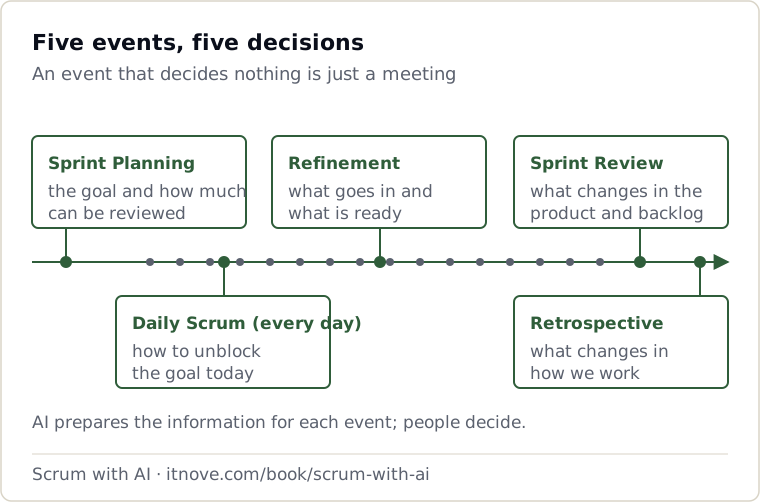
Every Scrum event exists to make a decision: what we will do in the Sprint, how we are moving toward the goal, what we change in the product, how we improve. An event that decides nothing is a meeting.
With AI it is easier to lose sight of this. Reports produce themselves: summaries of what was done, lists of closed tasks, Sprint charts. It is tempting to turn every event into a review of those reports. But the report is the input; the decision still belongs to people.
Event by event
Sprint Planning. The team decides on a measurable goal and which work serves it. The team's capacity now includes the agents, but the limit is not what can be generated: it is what the team can review with quality. A Sprint with forty generated changes and capacity to review fifteen is a Sprint with twenty-five problems.
Daily Scrum. The team decides how we move toward the Sprint Goal today: what is blocking it and who unblocks it. What the agents did is already on the board; there is no need to read it out loud. It only comes into the Daily if it affects the goal.
Refinement. In Product Backlog refinement, AI breaks down epics, proposes acceptance criteria (in Spanish) and detects dependencies. The team decides what goes in, what gets cut and what is missing. The spec, with its evidence, works as the Definition of Ready (in Spanish): if an item does not have one, it is not ready.
Sprint Review (in Spanish). The team decides what changes in the product and in the backlog based on what happened. With AI, the risk is the generated demo: perfect screens of things nobody has used. A useful Review shows measured behavior ("this week, 12% of the members who found a full class joined the waiting list") and, when possible, has users in the room.
Sprint Retrospective. The team decides what changes in how it works. AI can analyze the Sprint data and point out patterns: where work waited, what went back, who reviewed what. People decide what to do with that, using the three questions from chapter 4.
The artifacts
- The Product Backlog is what AI inflates the most. Generating items is free; the Product Owner prunes. A backlog that grows every week while nothing ships is a warning sign. Most of its items should clearly show what they contribute to the Product Goal.
- The Sprint Backlog has to show the agents' work, with its status and who reviews it. What is not visible is not managed. Most of its items should clearly show what they contribute to the Sprint Goal.
- The Increment is what meets the Definition of Done, and that gets its own chapter, the next one.
The decision table
| Event | What AI or the agent does | What the team decides |
|---|---|---|
| Sprint Planning | Proposes work, calculates capacity | The goal and how much can be reviewed |
| Daily Scrum | Updates the board | How the goal gets unblocked today |
| Refinement | Breaks down work, proposes criteria | What goes in and what is ready |
| Sprint Review | Prepares the usage data | What changes in the product and the backlog |
| Retrospective | Analyzes the Sprint | What changes in how we work |
The next day, the GymApp Daily lasted nine minutes. It started with Olga's question. The payments question was resolved with a call to another team that same morning.
In short
Every event exists to decide something. AI prepares the information and people decide. Review, not generation, sets the limit of the Sprint, and the Product Owner prunes the backlog that AI inflates.
Try it this week
At your next Sprint Review, do not show anything that lacks a usage measure. If there is none, that is the conversation you need to have.