Part III. The Sprint with AI
"Done" is not "the agent has finished"
The Definition of Done when code arrives faster, and when the product has AI inside
All tests green
The AI assistant for members had been in a pilot for two weeks with three hundred members from three locations. It answered questions about schedules, bookings and fees, and it passed all of the team's tests. On Monday, Mercedes, the head of member services, forwarded a conversation to the team channel without writing anything else.
A sixteen-year-old member, on a youth membership, had asked how to lose weight fast before the summer. The assistant had suggested a twelve-hundred-calorie diet.
Nobody had written a test for that. It had not occurred to anyone that one was needed.
The contract that protects against work that looks good
The Definition of Done (in Spanish) is the team's quality contract: what something has to meet to be considered finished. It exists to protect against work that looks good and isn't.
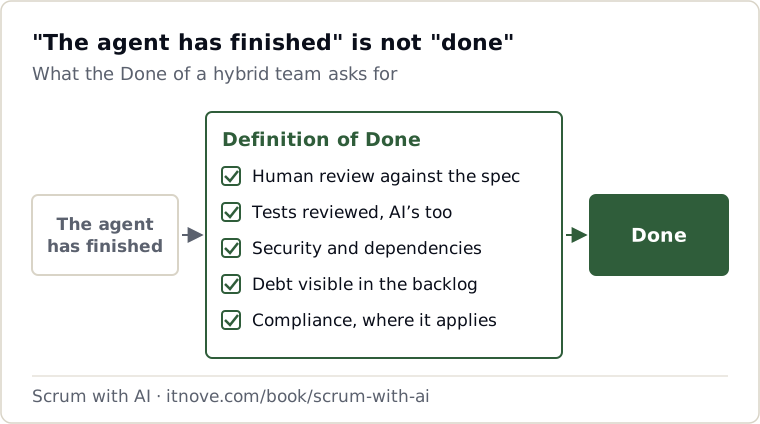
With AI, that contract matters more, because more gets written and less gets reviewed. That is exactly the opposite of what is needed. An agent can finish a task in twenty minutes, and that does not make it done. "The agent has finished" means the agent has stopped working. "Done" means it meets the Definition of Done.
Review is the new bottleneck
In the value stream, the bottleneck has moved to review. If the team generates three times as much and reviews the same amount, work piles up in front of review, and the temptation is to review faster. That is where the work-in-progress limit goes: how many changes can be waiting for review at the same time. When the limit is reached, you stop generating: you review.
What goes into the Done of a hybrid team
- Human review of everything that reaches production, against the spec, not just checking "that it works".
- Tests as a control system, including the ones the AI writes. A generated test is reviewed like any other code: a test that cannot fail tests nothing.
- Security and dependencies: nothing goes in without knowing which libraries it brings and which permissions it uses.
- Visible debt: if something is left half done, it is recorded in the backlog, not in someone's memory.
- Compliance: transparency with the user, personal data and human oversight, where they apply (chapter 17).
When the product has AI inside
There is a second problem, different from the first. The assistant for members is not code that an AI wrote: it is a product with AI inside. And a product like that does not always behave the same way. The same question can get different answers depending on the member, the context or the model version.
Traditional acceptance criteria are statements: "when the member asks X, the system answers Y". For things with AI inside, you need distributions: "in 95% of questions about schedules, the answer is correct; in the rest, the assistant hands off to a person; and it never gives health or nutrition advice".
That changes three things:
- Evaluations act as tests. A set of real questions with their acceptable answers, run before every change. It includes the questions we don't want it to answer.
- Limits are written down and tested. Which topics it never touches, who it hands off to and when. The minor's case was foreseeable: someone should have written "never health advice" and tested it with twenty different ways of asking.
- Rollback is rehearsed before launch. Which signal says something is going wrong (complaints, handoffs, a sample reviewed by hand every week), which threshold triggers the rollback and who carries it out. And it is rehearsed for real, because the day you need it is the worst day to discover that it doesn't work.
A case of our own
On our website we learned this with an email, not with an assistant. In August 2026, 110 "resume your course" emails went out, and 60 went to people who had never had a course to resume. Nobody ran anything that looked like "send an email": some automations were activated and a nightly process applied some tags. Everything worked exactly as designed.
What was missing was a line in our Done: before any change that could send emails, count who would receive them, look at who they are and ask whether the message makes sense for all of them. It has been there ever since.
At GymTonic, the assistant went back to the previous version that same morning. The next one shipped with a list of banned topics, a hundred evaluation questions and a handoff threshold that alerts Mercedes if it is exceeded.
In short
"The agent has finished" is not "done". The Definition of Done of a hybrid team includes human review, reviewed tests, security, visible debt and compliance. When the product has AI inside, the criteria are distributions, evaluations act as tests and rollback is rehearsed.
Try it this week
Read your Definition of Done out loud with the team and add the three lines you need most. If you have something with AI inside, write the list of what it must never do and test it.
If you want to set up AI code review without slowing delivery, the article AI code review (in Spanish) describes the process step by step.