Part IV. Value, measurement and more than one team
Look at the whole stream, not your piece
The value stream, from the idea to the member
Two weeks and three months
When the member assistant finally reached every gym, Ramón asked Lorena for something unusual: to reconstruct everything that had happened, with dates, from the moment the idea came up until people started using it. Lorena pulled from the task tool, the emails and the meeting minutes.
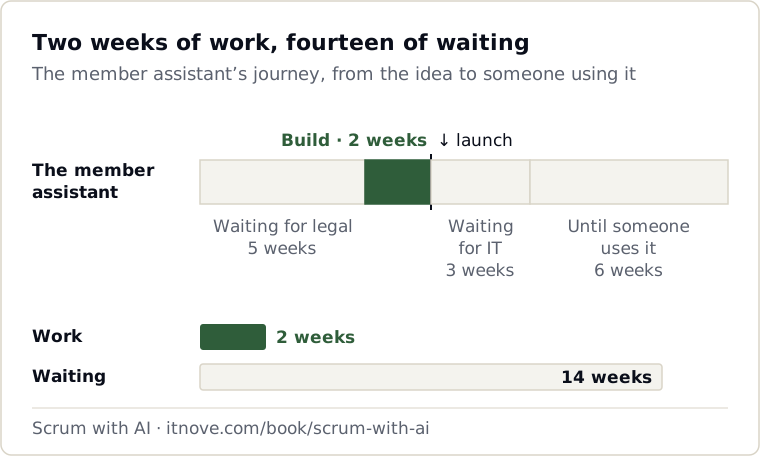
The result filled a wall. The team had taken two weeks to build the first version. Before that, it had waited five weeks for legal to review how the data was used. After that, three weeks for IT to open access to the class calendar. And after the launch, six weeks went by before front desk started recommending it, because nobody had explained to them what it was for. Two weeks of work and more than three months of waiting.
The full journey
The value stream is the journey of an idea until someone uses it and it changes something for them: discover, decide, build, review, deploy, adopt and measure. It is not the development team's piece: it is the whole path.
Looking only at your piece is misleading. A team can greatly improve what it does and change nothing about how long value takes to arrive, because the time is lost before or after its part of the process.
Where AI speeds things up and where it creates queues
AI speeds up some steps much more than others. Writing code, drafting documents, preparing tests: there the improvement is huge. Approving, meeting legal requirements, coordinating with other teams or training the people who will use the system: there it changes little.
And when one step speeds up and the next one does not, work piles up in front of the next one. If writing is ten times faster and reviewing is not, there is a queue at review. If the team builds three times as much and legal reviews the same amount, there is a queue at legal. AI does not remove bottlenecks: it moves them and, if nobody is watching, it makes them bigger.
Optimizing your piece makes the whole worse
It is an old idea in flow management: improving a part that is not the bottleneck does not improve the system, and it can make it worse. More work finished in development means more work waiting at the next step, more things half done and more time until something arrives whole.
At GymTonic, the team building faster would not have brought the assistant a single day closer to members. What would have brought it closer was starting the legal review in parallel, requesting calendar access on day one and preparing front desk before the launch.
Map the stream with times
A value stream map (the technique comes from Toyota and was popularized by Mike Rother and John Shook in Learning to See, 1999) is built with two times: work time and wait time. You almost always wait much longer than you work. For the assistant, work added up to two weeks; waiting, fourteen.
AI helps build this map: it can reconstruct the journey of each item from the dates on the board, the emails and the logs, and calculate how much time it spent in each step. What it does not do is decide what to change. That is decided with the people from each step in the same room, because most waits do not belong to anyone in particular: they sit between two teams.
The stream ends at adoption
There is a common mistake in AI projects: considering the stream finished when the system reaches production. The stream ends when people use it and something changes. Many AI use cases die between deployment and adoption: they work, nobody uses them, and after a year they are switched off.
For the assistant, the six weeks until front desk recommended it were the most expensive wait: the system was already paid for and running, and it delivered nothing.
What comes next
Looking at the whole stream changes the next two conversations. What to measure: the whole stream, not the team's velocity (chapter 14). And how to organize several teams: around the value stream, not around technical areas (chapter 15).
In short
The value stream runs from the idea until someone uses it and it changes something for them. AI speeds up some steps and creates queues in others. Optimizing your piece does not improve the whole: map the stream with its wait times and follow it all the way to adoption.
Try it this week
Take an item your team finished recently and reconstruct its journey with dates, from the idea until someone used it. Mark where it waited. The longest wait is probably not in your team.
To put a number on those waits, you have the calculator for the cost of your slow delivery, and to see how queues form, the Kanban flow simulator.